

Our Vision: Illuminating the cell biology in the behaving brain
In modern neuroscience, a significant chasm exists between molecular cell biology and systems-level circuit analysis. While we understand many of the "parts" of a neuron and the "outputs" of the brain, we rarely understand the intermediate logic that connects the two. Our lab is dedicated to bridging this gap. We investigate how nanoscale dynamic events occurring within specialized subcellular compartments, such as the primary cilium and nucleus, shape molecular signaling, gene expression and neuronal function, and explore their physiological significance across scales.
What We Do: Following Biology Across Scales
Unified by expertise in both cell biology and systems neuroscience, our lab formulates and addresses questions across biological scales. We integrate molecular, cellular, physiological, behavioral and computational approaches according to the biological question.
Biological Discovery & Perturbation: We investigate unusual or poorly understood molecular/cellular mechanisms in the adult brain & develop targeted approaches to interrogate their functions.
Functional Significance: We determine how these mechanisms influence neuronal function,
circuit activity and behavior.
Across-Scale Investigation: We follow the biology across the scales necessary to answer the question, from subcellular signaling and gene expression to neuronal activity, circuits, computation and behavior.
Core Research Program I:
Decoding the Signaling Logic of the Neuronal Primary Cilium
Historically, neuroscience has been defined by an intense focus on how the structure and composition of axons and dendrites enable neurons to compute information and form the circuits that drive brain function. Our lab is asking a fundamental, long-overlooked question: What is the functional role of the primary cilium in the adult brain?
While long recognized as a developmental organelle, the cilium’s role in the mature nervous system remains a critical, unexplored frontier. We are working to establish the concept of the cilium as a computational microdomain, a specialized "biological antenna" that allows neurons to interpret complex neuromodulatory signals. Our ongoing research seeks to characterize how these structures enable neurons to decode neuromodulatory signals that shape learning and emotions.
By investigating how primary cilia bridge dynamic neuronal activity and experience-dependent gene regulation, we aim to provide a novel mechanistic framework for the cognitive and affective phenotypes characteristic of ciliopathies like Bardet-Biedl syndrome and neurodevelopmental disorders such as Autism Spectrum Disorder (ASD). By establishing the primary cilium as a specialized signaling compartment in mature neurons, our work seeks to understand how subcellular organization contributes to neuronal function, circuit dynamics and behavior.
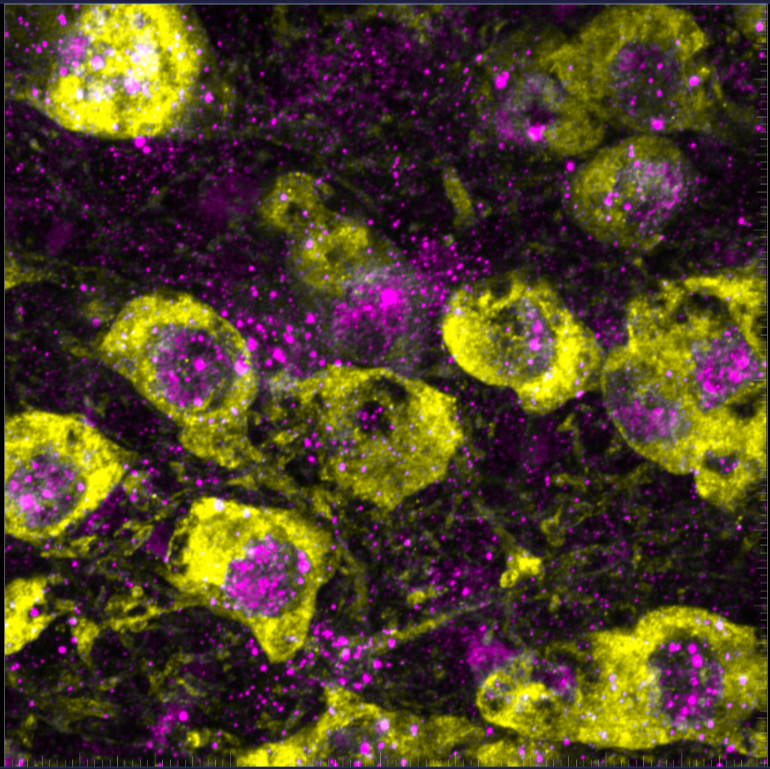
3D volume image of mouse striatum
Yellow: neuronal cilia
Blue: serotonin axons
Red: Nuclei
In vivo 1P calcium imaging of spiny projection neurons in the striatum of freely-moving mouse
Core Research Program 2:
Noncanonical Nuclear Logic in Mature Neurons
We are interested in how the neuronal nucleus organizes gene expression to support learning and memory. This program focuses on two distinct classes of nuclear proteins that have been "re-purposed" in the adult brain:
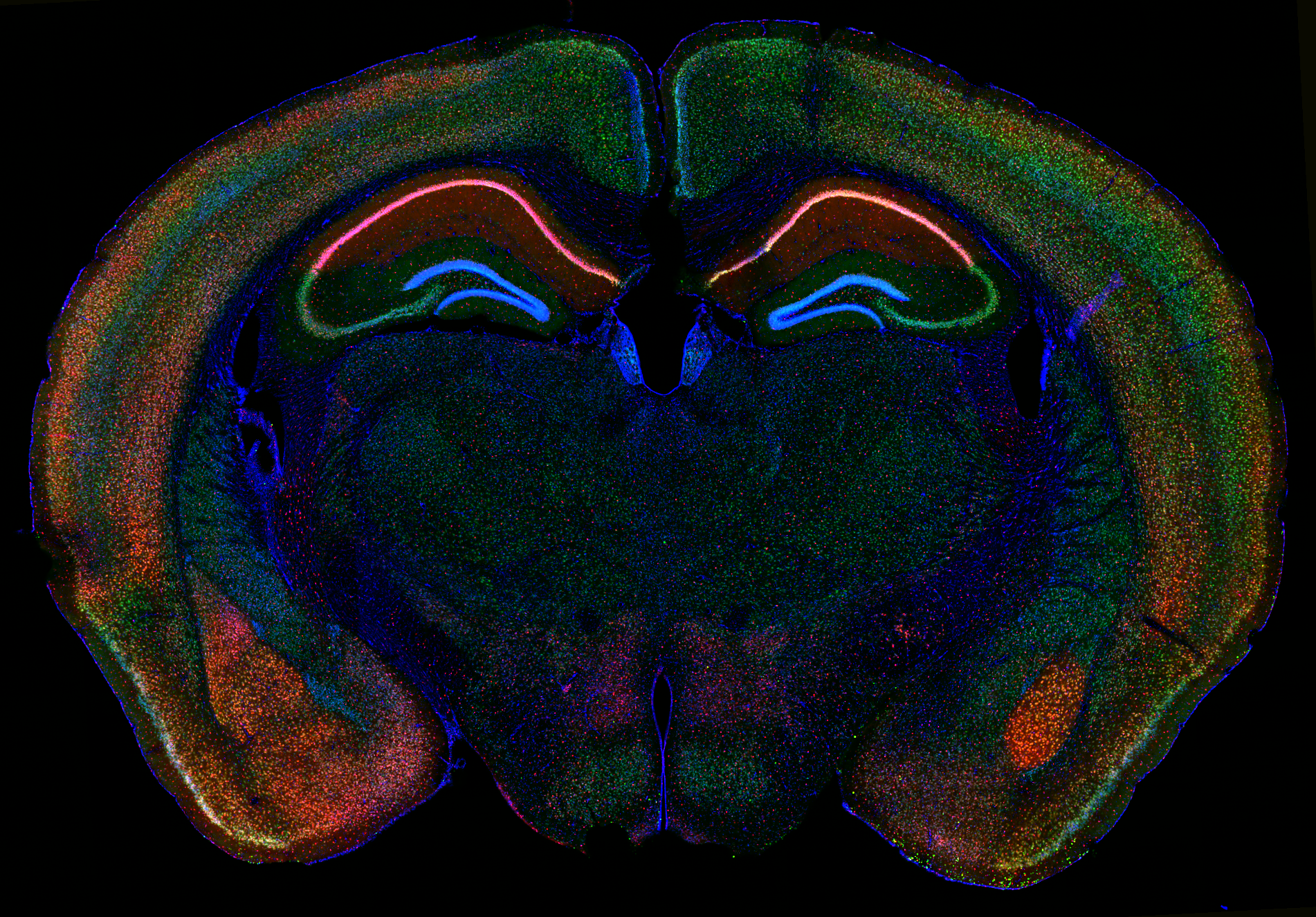
Redefining Cell-Cycle Regulators
We investigate how proteins traditionally associated with cell-cycle regulation are repurposed in mature, post-mitotic neurons for entirely non-cell-cycle functions. We seek to uncover the molecular functions these proteins have acquired, from RNA regulation to nuclear organization, and understand how cell-cycle machinery has been adapted to support the specialized biology of mature neurons.
From Synaptic to Nuclear Scaffolds
Our lab investigates specialized scaffold proteins historically recognized for their critical roles in neurotransmission during development and their link to movement disorders e.g. ataxia and dystonia. We have discovered that these proteins are uniquely enriched in the nuclei of specific neuromodulatory cell types in the adult brain, a departure from their established synaptic functions. We are exploring how these proteins are repurposed within the nucleus and how their noncanonical functions influence neuronal physiology, motor coordination and learning.
Our Training Signature: Developing "Multilingual" Scientists
The hallmark of our lab is training scientists who can think across biological scales. We believe researchers should develop deep expertise while becoming “multilingual” enough to connect ideas across molecular, cellular and systems biology.
Trainees develop depth in their own areas while gaining exposure to complementary approaches across molecular biology, imaging, behavior and quantitative analysis. Our training emphasizes the ability to recognize connections across scales, identify the level of explanation a question requires, and select (or collaborate for) the approaches needed to answer it rigorously.
The views and opinions expressed herein are those of the author(s) and do not represent the views and opinions of the National University of Singapore or any of its subsidiaries or affiliates